
Why Augmentation Beats Automation for Business Growth
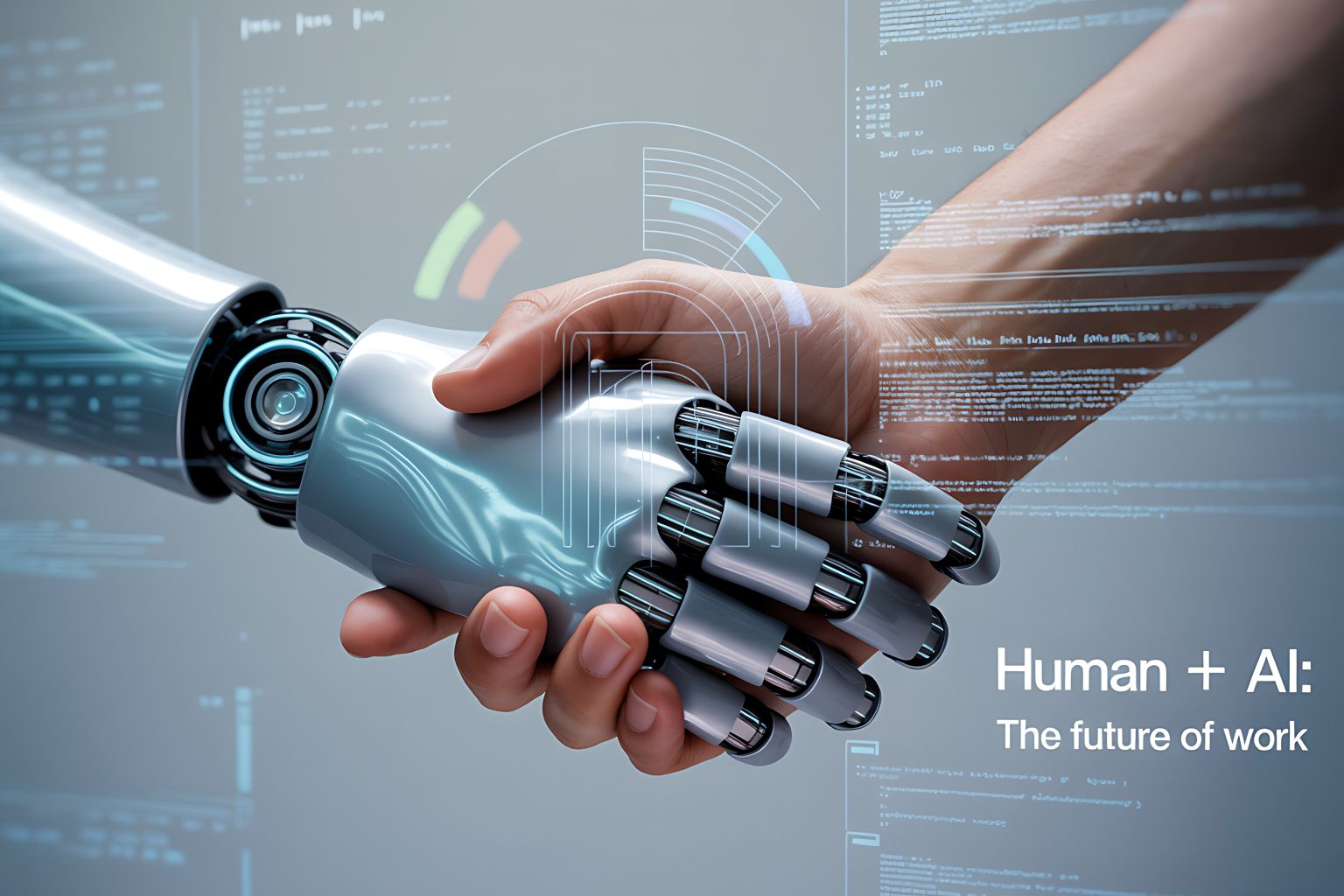
Human-AI collaboration separates the organisations achieving real AI impact from those stuck in endless pilots. The difference isn’t technology—it’s whether you’re designing for augmentation or settling for automation. Most executives miss this distinction entirely.
There’s a fundamental misconception driving most AI implementations today. Executives look at artificial intelligence and see a cost-reduction mechanism—a way to do the same work with fewer people, faster processes, and leaner operations. The logic seems irrefutable: automate routine tasks, eliminate redundancy, capture efficiency gains.
This approach isn’t wrong. It’s just incomplete. And that incompleteness is costing organisations the transformative potential AI actually offers.
Recent research examining AI adoption across nearly 2,000 organisations reveals a striking pattern: the companies achieving meaningful enterprise-level impact from AI aren’t primarily focused on automation and cost reduction. They’re pursuing something fundamentally different—augmentation, growth, and innovation. The distinction matters more than most leaders recognise.
The Growth-Versus-Efficiency Divide
Most organisations approach AI with efficiency as their primary objective. This makes intuitive sense—AI can process information faster, handle repetitive tasks without fatigue, and operate continuously without breaks. The efficiency case writes itself.
But here’s what the data reveals: organisations that set growth and innovation as objectives for their AI initiatives consistently outperform those focused solely on efficiency. Those pursuing innovation report improved customer satisfaction, competitive differentiation, profitability gains, and revenue growth at significantly higher rates than their efficiency-focused counterparts.
The high-performing organisations—roughly six percent of those surveyed—share a distinctive characteristic: they don’t treat AI as a cost-reduction tool. They treat it as a catalyst for business transformation. They’re more than three times more likely to say they intend to use AI for transformative change rather than incremental improvement.
This isn’t about ignoring efficiency. Eighty percent of respondents include efficiency as an AI objective. But the organisations seeing real impact add growth and innovation to that foundation rather than stopping at cost reduction.
Why Augmentation Creates Value Automation Cannot
The distinction between automation and augmentation isn’t semantic. It represents fundamentally different theories about where AI creates value.
Automation asks: What human tasks can AI replace?
Augmentation asks: How can AI amplify human capabilities?
The distinction manifests in where organisations see revenue impact. Revenue increases from AI concentrate in marketing and sales, strategy and corporate finance, and product and service development. These aren’t administrative functions ripe for automation. They’re high-judgment domains requiring creativity, relationship-building, and strategic thinking—precisely the areas where human expertise remains essential.
Consider what these functions have in common: they require synthesising complex information, making decisions under uncertainty, and adapting to nuanced human responses. AI doesn’t replace the human capabilities required for success in these domains. It amplifies them. A marketing strategist augmented by AI can test more hypotheses, analyse more customer data, and iterate faster. The strategic judgment remains human. The execution capacity multiplies.
Innovation follows the same pattern. Sixty-four percent of organisations report that AI is enabling their innovation—but this happens through augmentation, not automation. AI expands what’s possible for human creators and strategists. It doesn’t replace the creative and strategic functions themselves.
The Workflow Redesign Imperative
High-performing organisations share another distinctive practice: they fundamentally redesign workflows rather than simply inserting AI into existing processes. These organisations are nearly three times more likely than others to have redesigned individual workflows around AI capabilities.
This matters because workflow redesign is one of the strongest contributors to achieving meaningful business impact. Organisations that bolt AI onto existing processes capture incremental efficiency gains. Those that reimagine how work gets done capture transformative potential.
The difference is architectural, not technical. It requires asking different questions:
- If humans and AI were designing this workflow from scratch, what would it look like?
- Which decisions require human judgment, and which can be delegated or augmented?
- How do we create collaboration frameworks that multiply capability rather than just transfer tasks?
- Where are our best people trapped in work that doesn’t require their expertise?
This architectural thinking distinguishes organisations achieving enterprise-level impact from those stuck in pilot phases. It’s not a technology problem. It’s an organisational design challenge.
The Workforce Clarity Gap
One of the most telling indicators of augmentation versus automation thinking appears in how organisations approach workforce planning. Current expectations reveal significant uncertainty: 32 percent expect workforce decreases, 43 percent anticipate no change, and 13 percent project increases.
This spread suggests something important: most organisations lack clear frameworks for understanding how AI will reshape their human capabilities. They’re making implementation decisions without clarity on the human-AI collaboration model they’re building toward. A structured AI readiness assessment can provide the clarity needed to move forward strategically.
Interestingly, high performers are more likely than others to expect meaningful change in either direction—increases or decreases. They’re not frozen by uncertainty. They’ve developed clearer perspectives on how human and AI capabilities will integrate.
Meanwhile, most organisations continue hiring for AI-related roles. This signals a recognition—even if implicit—that successful AI integration requires expanding human capabilities alongside digital workers. Organisations aren’t choosing between humans and AI. They’re building hybrid workforces that combine both.
The challenge is that most organisations are doing this reactively rather than strategically. Without clear human-AI collaboration frameworks, workforce evolution happens by accident rather than design.
The Path Forward: Designing Human-AI Collaboration
The evidence points to a clear conclusion: organisations capturing transformative value from AI approach it as an augmentation strategy, not an automation initiative. They redesign workflows around human-AI collaboration. They set growth and innovation as objectives alongside efficiency. They develop clear frameworks for how human and digital workers will create value together.
For organisations still in pilot phases—which represents the majority—this creates both challenge and opportunity. The challenge is that capturing AI’s full potential requires more than technology deployment. It requires organisational redesign.
The opportunity is that most competitors haven’t made this transition either. Organisations that develop sophisticated human-AI collaboration frameworks now will create competitive advantages that pure automation approaches cannot match.
The question isn’t whether to pursue AI efficiency gains. It’s whether to stop there—or to design the human-AI collaboration architecture that transforms what your organisation can achieve.
What This Means for Your Organisation
The shift from automation thinking to augmentation thinking requires systematic assessment of three interconnected dimensions:
Workflow Architecture: How are your current processes designed, and where would human-AI collaboration create multiplicative value rather than simple task transfer?
Cultural Readiness: Does your organisation’s culture support the kind of human-AI collaboration that drives innovation, or does it default to replacement thinking?
Capability Integration: What frameworks exist for determining optimal task allocation between human expertise and AI capabilities?
Most organisations attempting AI transformation lack structured approaches to these questions. They deploy AI tools without redesigning the workflows those tools should enhance. They pursue efficiency without building the collaboration frameworks that enable growth.
The organisations succeeding with AI transformation understand something their competitors miss: this isn’t primarily a technology challenge. It’s an organisational design challenge. The technology is available. The question is whether your organisation is architected to capture its transformative potential.
ALTEQ specialises in AI transformation strategy for mid-market organisations, with particular focus on human-AI collaboration frameworks that drive growth rather than just efficiency. Our Digital Business Architecture methodology helps organisations design the workflows, cultural frameworks, and capability integration strategies that distinguish high performers from those stuck in pilot phases.
Ready to assess your organisation’s readiness for AI-augmented growth? Take our free 5-minute Digital Maturity Assessment at alteq.au