
Human-AI Collaboration: Why Augmentation Beats Automation
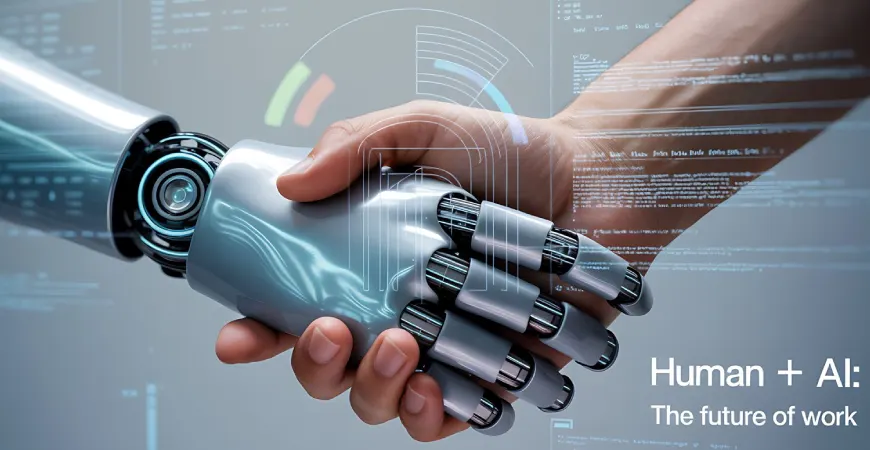

Most AI projects are sold on the wrong promise.
When a board signs off on an AI investment, the pitch is almost always the same: take a process, remove the humans, count the savings. The slide deck calls it transformation. The finance team calls it headcount reduction. The technology gets deployed. And then, twelve months later, the operational gains quietly underperform the business case.
This isn't a story about AI failing. It's a story about CEOs being sold the wrong outcome.
The companies generating real, compounding ROI from artificial intelligence aren't the ones automating fastest. They're the ones augmenting hardest — designing AI into the way work happens, not around it. And the gap between those two strategies is becoming the single biggest determinant of whether AI investment pays back or drags on the P&L.
Why automation has a low ceiling
Automation optimises a task. That's its whole job. You take a defined, repetitive process — invoice matching, ticket routing, data entry — and you remove the human cycles required to run it. The ROI is real, but it's bounded. Once the task is automated, the ceiling is hit. There's nothing left to optimise.
The McKinsey Global Institute has been tracking this for years, and their consistent finding is that pure task automation captures only a fraction of AI's potential economic value. Their generative AI work estimates the technology could add $2.6 to $4.4 trillion annually to the global economy — and the bulk of that value sits in augmentation use cases, not full replacement. Marketing, sales, software engineering, R&D. The work that benefits from human judgement amplified by machine speed, not subtracted by it.
IBM's research on top-performing AI adopters lands on the same conclusion from a different angle. The leading companies in their global study aren't the ones with the most automated workflows. They're the ones treating AI as an operating model decision — embedding it into how their people work, decide, and create. Across their dataset, these organisations see materially higher returns on AI investment than their peers. Not because they bought better technology. Because they designed better systems around it.
What augmentation actually changes
Augmentation isn't "AI plus a human." That framing is lazy and it's why most augmentation projects also underperform.
Augmentation is a capacity redesign. You're not asking "how do we do this task faster?" You're asking "what does this team do now that they couldn't do before?" The unit of analysis shifts from the task to the role, and from the role to the operating model.
A finance team augmented with AI doesn't just close the books faster. They start running scenario analyses they previously couldn't afford the time for. A sales team augmented with AI doesn't just write emails quicker. They start qualifying opportunities they previously didn't have the bandwidth to look at. The cost line might not move much. The revenue line does.
Automation collapses cost on existing work. Augmentation expands the work itself.
Why this matters more for the mid-market
Enterprise companies can absorb the inefficiency of automation-first strategies because they have the scale to run multiple parallel transformations. Mid-market companies cannot. Forbes Tech Council contributors have been making this point with increasing volume over the last year: mid-market organisations need AI strategies that compound, not strategies that save.
The maths is straightforward. A 200-person company that automates 15% of its operational tasks captures a one-time efficiency gain and moves on. The same 200-person company that augments 60% of its workforce builds a capability moat — every team member operates with more leverage, makes faster decisions, and produces work that previously required hiring. The second company isn't running cheaper. It's running fundamentally differently.
This is also why mid-market AI projects fail more visibly than enterprise ones. There's less margin for misallocated investment. Picking the wrong outcome to optimise for — cost reduction instead of capacity expansion — shows up on the P&L within a year. There's no portfolio effect to hide behind.
The operating model question
The real question for a CEO evaluating AI strategy isn't what should we automate? It's what would our organisation look like if every team had 30% more capacity?
That's an operating model question, and it has very little to do with technology procurement. It has to do with how roles are structured, how decisions are made, how work flows between teams, and where the bottlenecks sit. AI is the tool that unlocks the answer. But the answer itself is a design problem, not a deployment problem.
This is also where most consulting-led AI strategies quietly break down. They optimise for what's automatable rather than what's transformable. They produce a roadmap full of pilot projects and proof-of-concepts, and very little integration into the actual operating rhythm of the business. Twelve months in, the technology is live and the operating model is unchanged. That's the expensive version of failure.
Where this leaves CEOs
The teams getting AI right in 2026 aren't the ones with the biggest budgets or the flashiest tools. They're the ones treating human-AI collaboration as a structural capability — designed into the architecture of their workforce, not bolted onto the side of it. The technology is becoming commoditised quickly. The advantage is shifting to organisations that know how to use it as leverage rather than substitution.
The question to bring to the next board meeting isn't whether to invest in AI. That decision is already made for most mid-market companies, whether they realise it or not. The question is whether the investment is being designed for cost reduction or capacity expansion — and whether the operating model is built to absorb the difference.
At ALTEQ, this is the work we do with mid-market leaders across Australia: designing AI workforce architectures that amplify capability rather than replace it. The companies seeing the strongest returns are the ones asking the augmentation question first.
The rest are still buying the wrong outcome.
Let's Build Your AI Foundation.